

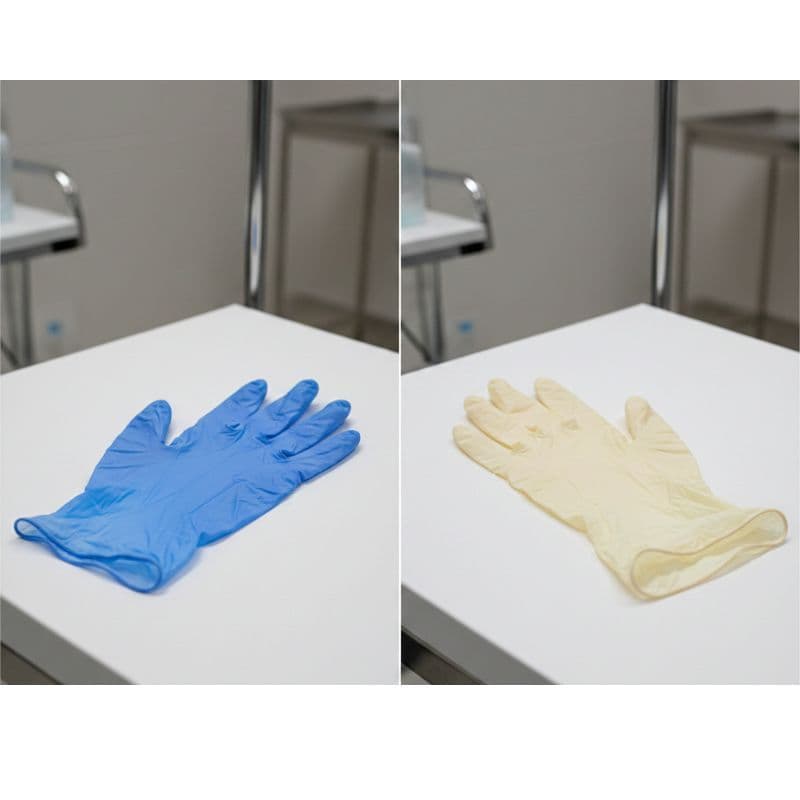
Choosing the correct examination glove is not simply a purchasing decision — it is a risk management decision.
Hospitals, laboratories, clinics, food facilities, and industrial environments rely on gloves to serve as the first line of protection against contamination, infection, and hazardous exposure. Among the most commonly used materials are nitrile and latex.
While both serve similar purposes, their performance characteristics, safety considerations, and cost implications differ significantly.
This report provides a clear, practical, and professional comparison to help procurement teams and healthcare professionals make informed decisions.
Latex gloves are manufactured from natural rubber latex, a material derived from rubber tree sap. For decades, latex has been the standard in medical environments due to its exceptional elasticity and comfort.
• Superior Elasticity
Latex offers natural stretch and flexibility, allowing the glove to conform closely to the hand.
• Excellent Tactile Sensitivity
Healthcare professionals often prefer latex for procedures requiring precision.
• Comfortable Fit
The material adapts naturally to hand movements, reducing fatigue during extended wear.
• Cost-Effective in High Volumes
Latex gloves are typically less expensive than nitrile in standard market conditions.
Despite their advantages, latex gloves present several challenges:
• Latex Allergy Risk
Some individuals develop allergic reactions ranging from skin irritation to severe hypersensitivity.
• Limited Chemical Resistance
Latex does not perform as well against certain chemicals and solvents compared to nitrile.
• Degradation Over Time
Latex can break down faster when exposed to heat, ozone, or improper storage.
For institutions prioritizing universal safety policies, latex allergy risk is often the deciding factor in switching materials.
Nitrile gloves are made from synthetic rubber (nitrile butadiene rubber) and were initially developed as an alternative for individuals with latex allergies.
Over time, nitrile has evolved into the preferred material in many high-risk environments.
• Latex-Free Composition
Nitrile eliminates the risk of latex-related allergic reactions.
• Superior Puncture Resistance
Nitrile offers stronger resistance to tearing and needle punctures compared to latex.
• Excellent Chemical Resistance
It performs better against oils, fuels, solvents, and many chemicals.
• Durable & Long-Lasting
Nitrile maintains structural integrity even under extended use.
• Improved Modern Comfort
Advancements in manufacturing have significantly enhanced flexibility and tactile sensitivity.
• Higher Cost
Nitrile gloves typically cost more than latex.
• Slightly Reduced Natural Elasticity
Although modern nitrile is flexible, it may not stretch as naturally as latex.
However, in high-risk or regulated environments, the performance advantages often outweigh the cost difference.
Below is a simplified professional comparison:
Allergy Risk
Latex: Moderate to High
Nitrile: None (Latex-Free)
Puncture Resistance
Latex: Good
Nitrile: Excellent
Chemical Resistance
Latex: Moderate
Nitrile: High
Elasticity
Latex: Excellent
Nitrile: Very Good (Modern Grades)
Cost
Latex: Lower
Nitrile: Moderate to Higher
Recommended for High-Risk Medical Settings
Latex: Conditional
Nitrile: Strongly Recommended
Latex gloves may still be appropriate when:
• There is no allergy concern within the workplace
• Maximum tactile sensitivity is required
• Budget constraints are strict
• Exposure to aggressive chemicals is minimal
Dental clinics, general examinations, and short procedures may continue to use latex safely where policies allow.
Nitrile gloves are strongly recommended when:
• There is any risk of latex allergy
• Procedures involve bloodborne pathogens
• Sharp instruments are frequently handled
• Chemical exposure is possible
• Regulatory compliance requires latex-free environments
Most modern hospitals and laboratories now standardize nitrile to minimize institutional liability and ensure universal compatibility.
Procurement decisions must also align with regulatory standards.
Professional nitrile and latex examination gloves should comply with:
• EN 455 (Medical Gloves Standard)
• EN ISO 374 (Chemical Protection)
• ASTM D6319 (Nitrile Specification)
• FDA Registration (Where applicable)
Certification ensures gloves meet minimum performance thresholds for safety and quality control.
While latex gloves may appear less expensive per unit, cost evaluation should include:
• Allergy-related incidents
• Replacement frequency
• Tear and puncture rates
• Waste from glove failure
• Institutional policy shifts
In many cases, nitrile proves more economical over time due to reduced risk and longer durability.
Globally, healthcare facilities are increasingly transitioning toward nitrile gloves due to:
• Universal safety compatibility
• Improved manufacturing technology
• Higher compliance standards
• Increased awareness of latex allergies
The shift reflects a broader industry focus on preventive risk management rather than reactive problem solving.
Both nitrile and latex gloves offer reliable protection when used appropriately.
However, for organizations seeking:
Maximum safety
Reduced liability
Chemical resistance
Universal staff compatibility
Nitrile gloves are often the preferred professional choice.
Latex remains viable in controlled environments where allergy risks are fully assessed and managed.
Selecting between nitrile and latex gloves should be based on application, risk exposure, compliance requirements, and institutional policy — not price alone.
Understanding the structural, chemical, and safety differences empowers healthcare providers and procurement teams to make decisions that protect both professionals and patients.
The right glove is not just a product.
It is a commitment to safety, performance, and responsibility.


